There is a quiet assumption built into the hyperscale cloud model: once your data, applications, and workflows are deeply embedded, you will stay put.
Not because you love the pricing.
Not because the support is exceptional.
Not because the architecture is ideal.
You stay because moving feels risky.
That fear is where the AWS tax begins.
It shows up in hidden egress fees, opaque billing structures, premium-priced managed services, and application architectures that become harder to unwind every quarter. Over time, many organizations realize they are no longer buying infrastructure. They are funding dependency.
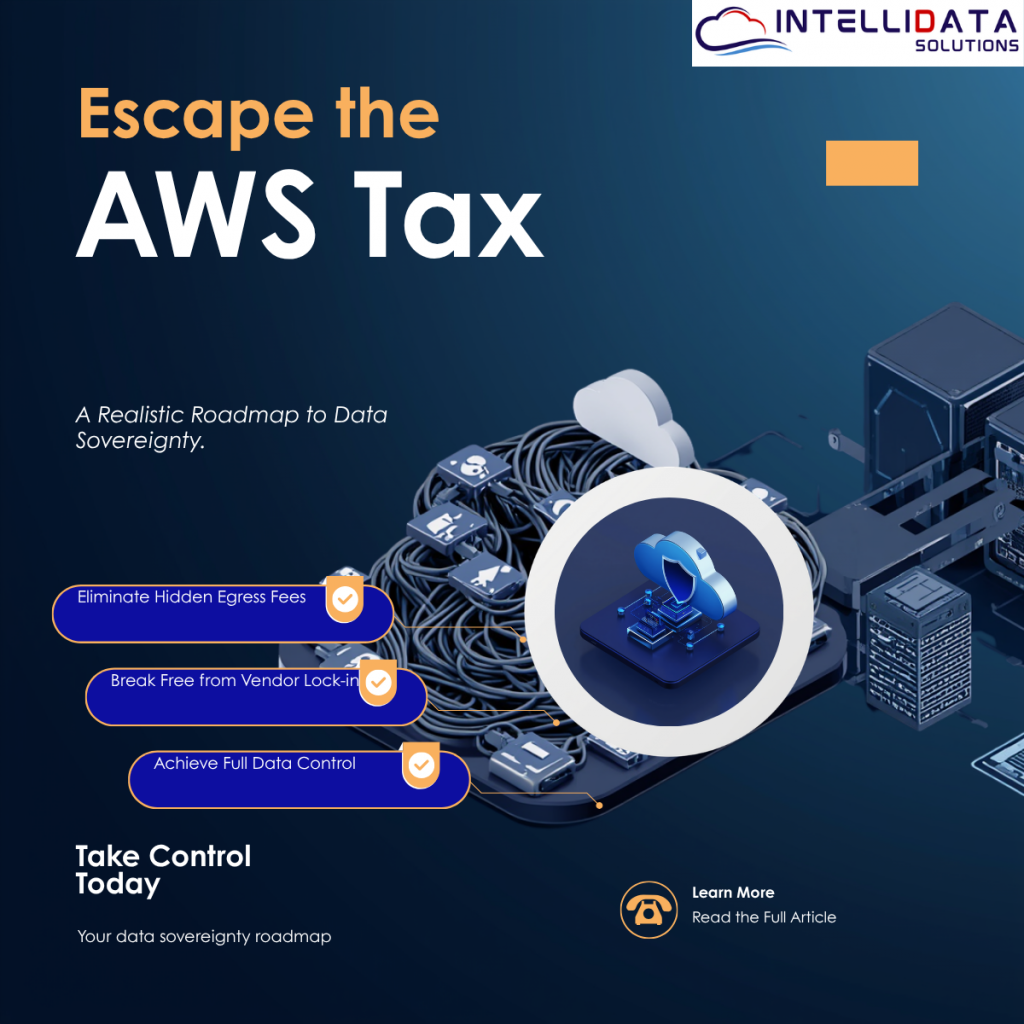
The good news is that escaping the AWS tax does not require a dramatic, all-at-once migration. It requires a realistic roadmap built around visibility, portability, performance, and control.
For CEOs, CTOs, and compliance-minded IT leaders, the goal is not simply to leave one provider. The goal is to regain leverage over your infrastructure, your costs, and your data strategy.
What the AWS Tax Really Looks Like
Most organizations do not experience cloud lock-in as a single painful event. They experience it as a gradual accumulation of friction.
At first, the environment looks flexible. Provisioning is fast. New services are easy to spin up. Teams move quickly. But as usage grows, so do the hidden costs.
Egress fees begin to punish data movement. Inter-service charges become harder to forecast. Managed services simplify deployment in the short term while increasing architectural dependence in the long term. Billing grows more complex, not less. What started as operational agility turns into financial drag.
This is the part many cloud providers hope you will tolerate. They count on the idea that leaving feels more expensive than staying.
That is why the first step toward data sovereignty is not migration. It is recognition.
If your cloud bill is difficult to explain, difficult to predict, and difficult to reduce without reworking your architecture, you are already paying the tax.
Step One: Identify the Hidden Fees and Billing Traps
Before you can create an exit path, you need a clear picture of where the money is going.
Most cloud invoices do not just reflect compute and storage. They often include layers of incidental cost that grow quietly over time:
- Data egress charges for moving information out of the environment
- Premium costs for managed databases, analytics tools, and proprietary orchestration services
- Backup, firewall, and security add-ons that are not truly optional
- Cross-region or cross-zone transfer fees
- Overprovisioned resources that were never rightsized after deployment
- Administrative complexity that consumes internal engineering time
The billing trap is not only about price. It is about unpredictability.
When infrastructure becomes difficult to model financially, it becomes difficult to govern. Leaders lose confidence in forecasting. IT teams spend valuable time chasing cost anomalies. Procurement loses leverage because pricing is too fragmented to benchmark cleanly.
A realistic migration roadmap starts with a cost and dependency audit.
That means identifying:
- Which workloads are most expensive to operate
- Which applications generate the most egress exposure
- Which services are tied to proprietary APIs
- Which workloads are easiest to move first
- Which compliance or performance requirements should shape the destination environment
This process usually reveals something important: not every workload needs to move at once, and not every dependency is equally painful. That is good news. It means you can prioritize strategically instead of reacting emotionally.
Step Two: Decouple from Proprietary Vendor APIs
This is where many cloud exit conversations stall.
Organizations often believe they are locked in because their infrastructure runs in AWS. In reality, they are usually locked in because their applications were designed around AWS-native services and proprietary service patterns.
That distinction matters.
Moving virtual machines is one challenge. Rebuilding application logic around portable patterns is another. The second issue is where long-term leverage is won or lost.
A realistic roadmap to data sovereignty includes architectural shifts such as:
Replace tightly coupled managed services where practical
If an application depends heavily on proprietary databases, messaging systems, or serverless workflows, evaluate whether open or portable alternatives can meet the same business need.
Use standard interfaces and abstractions
Applications built around open standards, containers, and infrastructure-as-code are easier to move, test, and replicate across environments.
Separate application logic from provider-specific tooling
The more business-critical workflows rely on a single cloud vendor’s ecosystem, the more every future change becomes expensive.
Reassess what truly needs to be “cloud native”
Not every workload benefits from hyperscaler-specific services. In many environments, simplicity, predictability, and control deliver greater long-term value than an expanding web of native integrations.
The goal is not ideological purity. It is practical portability.
You do not need to eliminate every provider-specific dependency overnight. You need to reduce the number of decisions that make future movement harder.
That is what gives your organization negotiating power again.
Step Three: Build for Portability Without Sacrificing Performance
One of the most persistent myths in infrastructure planning is that leaving a hyperscaler means accepting lower performance.
That assumption is outdated.
Performance is not reserved for big-box cloud providers. It comes from sound architecture, fast storage, sufficient compute, optimized networking, and responsive human support when problems arise.
Organizations can achieve performance parity, and in many cases operational improvement, by moving to infrastructure designed around actual workload needs instead of bundled cloud sprawl.
That means evaluating a destination environment based on questions like:
- Is storage SSD-backed and consistently fast under load?
- Is bandwidth constrained, metered, or truly built for scale?
- Are compute resources sized for real application behavior?
- Is GPU-backed infrastructure available for demanding workloads like VDI, AI, rendering, or engineering applications?
- Are backups, firewalls, and core security controls included by design or sold back as add-ons?
- Is support routed through layers of ticketing, or do real engineers actually know the environment?
This is where many organizations discover that the premium they are paying is not for better outcomes. It is for brand comfort.
At IntelliData, we see this frequently: companies assume they need hyperscaler pricing to maintain enterprise-grade speed, resilience, and security. In reality, they often need a better-aligned infrastructure partner.
Performance should be measurable. Pricing should be transparent. Support should be human.
Step Four: Reduce Concentration Risk
Data sovereignty is not only about cost control. It is also about operational resilience.
When too much of your business depends on a single ecosystem, outages hit harder. A billing issue, regional service disruption, or dependency failure can ripple across applications, customer experience, and internal operations.
That risk is not theoretical. Recent major cloud-related disruptions have affected critical services and downstream businesses, reinforcing the danger of over-concentration in any one platform. Internal reference files on AWS outage analysis and Azure-related business disruption highlight how service issues at scale can cascade into broad operational impact.
A realistic roadmap to sovereignty should include resilience planning such as:
- Identifying single points of cloud dependency
- Creating migration tiers by business criticality
- Designing backup and recovery policies that are not fully dependent on the same ecosystem
- Segmenting critical workloads where appropriate
- Ensuring your team can recover services without waiting on hyperscaler black-box support processes
Sovereignty is not just ownership of data. It is the ability to operate with confidence when conditions are less than ideal.
Step Five: Choose a Migration Strategy That Matches Reality
The fastest way to fail a cloud migration is to treat it like a branding exercise instead of an operational program.
You do not need a dramatic declaration that everything is moving now. You need a disciplined sequence.
For most organizations, that sequence looks something like this:
- Assess
Map applications, dependencies, spend, compliance requirements, and workload behavior. - Prioritize
Identify low-risk, high-value workloads that can move first and prove the model. - Decouple
Reduce dependency on proprietary services that create long-term friction. - Migrate in phases
Move workloads in a controlled order, with rollback planning and validation at each stage. - Optimize
After migration, tune performance, rightsize resources, and simplify operations for the new environment.
The best migrations do not feel chaotic. They feel methodical.
That is especially important for regulated organizations. If you operate in healthcare, defense, finance, or other compliance-sensitive sectors, the destination environment cannot simply be cheaper. It must also be designed to support requirements like HIPAA, SOC 2, and CMMC from the start.
What to Look for in a Better Alternative
Escaping the AWS tax is not just about leaving something behind. It is about choosing something better.
A strong infrastructure partner should offer:
- Transparent monthly pricing without surprise line items
- Security controls and backups built into the service model
- High-performance compute, SSD storage, and robust networking
- Real compliance readiness, not compliance theater
- Human support from engineers who understand your environment
- A migration process built around partnership, not generic templates
This is where the market often splits.
The big-box cloud model optimizes for scale.
A true infrastructure partner optimizes for your outcome.
That difference matters when uptime, speed, compliance, and business continuity are all on the line.
The Real Goal: Control
The most important outcome of cloud migration is not cost reduction alone, though that often matters. It is control.
Control over where your data lives.
Control over how your applications are designed.
Control over your monthly costs.
Control over performance expectations.
Control over compliance posture.
Control over who picks up the phone when something goes wrong.
That is what data sovereignty looks like in practice.
Not isolation. Not fear. Not complexity for its own sake.
Just an infrastructure strategy that serves your business instead of trapping it.
Final Thought
AWS counts on hesitation. It counts on the idea that moving feels too disruptive, too technical, or too risky to seriously consider.
But the longer organizations wait, the more expensive that assumption becomes.
The realistic path forward is not panic. It is a roadmap.
Start with visibility. Reduce lock-in. Re-architect where it matters. Choose infrastructure built for performance, transparency, and resilience. Move in phases. Regain leverage.
That is how you escape the AWS tax.
And that is how you build a cloud strategy that treats your business like a priority, not a line item.
Call to Action
Ready to build your path to data sovereignty?
Move beyond big-box cloud. Discover the IntelliData difference.
Schedule your free infrastructure consultation at IntelliDSI.com